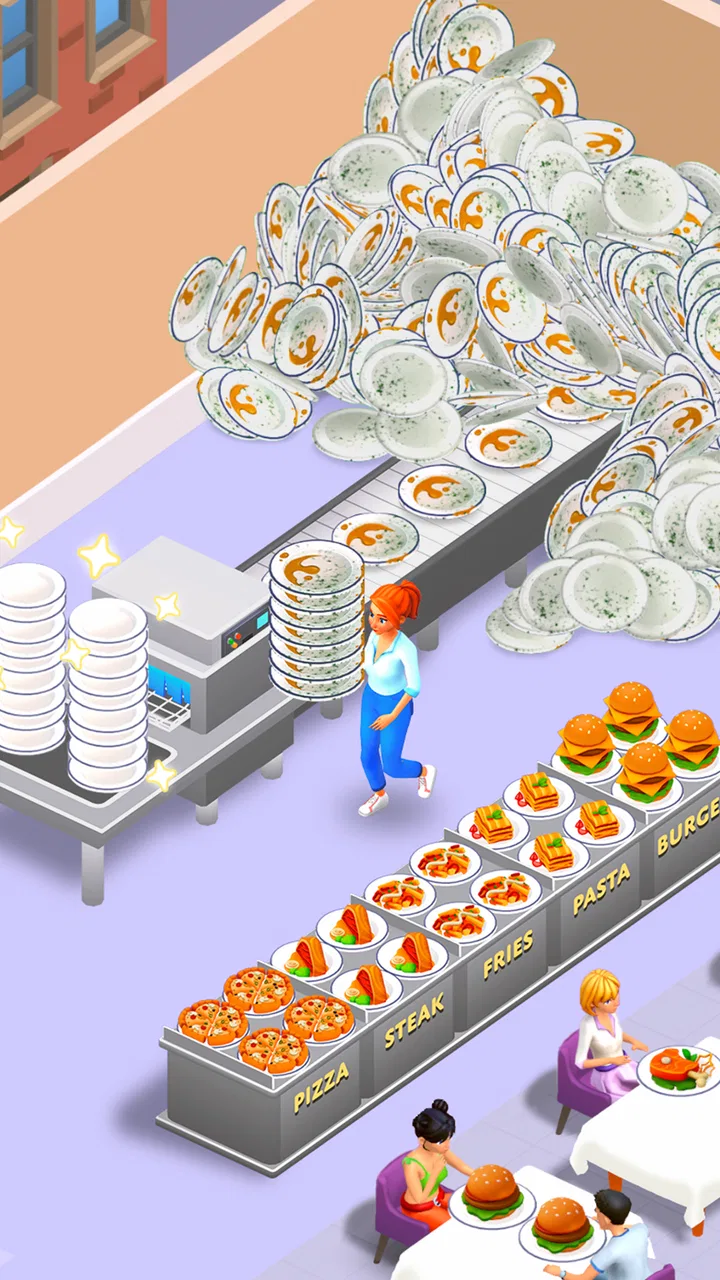
Suzy's Food Restaurant Game
- 4.2
- Rating
- 10.00M
- Installs
- Free
- Price

 Analysis by App-foxy
Suzy’s Food is the kind of restaurant simulation I can open for a few minutes while waiting for a bus, then continue later without needing to remember a complicated story. I cook, serve customers, and keep the restaurant moving through short bursts of activity. That simple loop is the main reason it feels approachable, but it also means the game depends heavily on quick visual decisions and repeated taps. In my experience, it is most enjoyable when I want light management rather than a deep business simulator.
Developed by Supercent, Inc., this free game sits in the simulation category and is suitable for Everyone. It has built a substantial audience, with an average rating of 4.3 from around 234 thousand ratings and more than 10 million installs. Those figures suggest that its straightforward restaurant theme reaches far beyond dedicated simulation fans. I can understand the appeal: the idea is immediately clear, the sessions are easy to start, and the kitchen setting gives the routine a pleasant sense of progress.
How the restaurant loop feels to use
The basic experience is built around managing food preparation and service. I am not asked to study a long tutorial before doing anything useful. Instead, the game presents the restaurant as a series of small tasks that can be understood through the action on screen. That makes it a comfortable starting point for someone who has never played a restaurant game before, especially a younger player or anyone who prefers learning by doing.
You May Also Like

 Blood Strike: 2.5 Anniversary
Blood Strike’s Loadouts Turn Every Drop Into a Tactical Gamble
A close look at Blood Strike’s custom loadouts: how fast access to signature weapons reshapes its battle royale rhythm, rewards preparation, and narrows the gap between fights.

 Pandora - Music & Podcasts
Pandora’s Music Is Easy to Start, but Harder to Recover
Pandora’s strength is its low-effort path from a seed to a station. Its weak spot is how much confidence it asks you to place in connection, setup, and quiet recovery.

 8 Ball Pool
 Is Built on Rivalries, Rematches, and Routine
A close look at the rivalries, rematches, shared routines, and unanswered safety questions that turn a quick pool match into a persistent mobile community.

 Samsung Music
’s Quiet Strength Is Playing What You Already Own
Its reach comes less from spectacle than from dependable access to a personal library. That simplicity is both the app’s strongest retention engine and its ceiling.

 AccuWeather: Weather Radar
AccuWeather Review: A Quick, Clear Forecast for Everyday Decisions
For everyday plans, the best forecast is the one you can understand quickly. AccuWeather makes rain timing, radar, and local conditions easy to act on, with a few trade-offs.

 Hill Climb Racing
Why Hill Climb Racing Still Turns Crashes Into One More Run
A tiny car, a bumpy hill and one more upgrade: Hill Climb Racing keeps resurfacing because its simple chaos makes every near-miss feel personal.
More From Our News Desk



The short description, “Suzy's Food,” is modest, while the broader store summary points toward cooking, serving, and handling the rush in a restaurant. That combination reflects the game fairly well: the attraction is not a complex culinary system but the rhythm of keeping customers served. I found the appeal strongest when I treated each session as a quick concentration exercise rather than as a long-form strategy game.
Navigation is generally easiest when I focus on the current customer flow instead of trying to inspect everything at once. A useful habit is to scan the whole kitchen before tapping. I look for the next required action, identify anything already waiting, and then work through the order in a deliberate sequence. This reduces frantic back-and-forth and helps when several visual elements compete for attention.
That habit matters because restaurant games can become confusing when the player reacts to the most noticeable object instead of the most urgent one. Suzy’s Food rewards a little planning, even though it presents itself as a casual game. I get better results when I prepare the next action mentally before finishing the current one. It is a small adjustment, but it makes the service loop feel less like random tapping.
Readability and navigation in everyday play
The kitchen theme gives the screen a logical structure: food-related actions belong in one mental area, customers in another, and service decisions connect the two. I found that visual logic more helpful than a dense menu system would have been. Someone who struggles with complicated navigation may appreciate being able to follow the restaurant scene rather than moving through several layers of settings.
At the same time, a busy service moment can make the screen harder to read. When multiple requests and actions appear together, I have to slow down and check what the game is asking me to do. Players with reduced visual attention, reading difficulties, or a preference for calm interfaces may find the rush less comfortable than the quieter parts of a session.
One practical approach is to play in a stable position with the phone held at a comfortable distance. I avoid shrinking the game into a small floating window or playing while walking, because both make it easier to miss a visual cue. The game is much more manageable when I give the restaurant screen my full attention for a short period.
I also recommend turning off distractions around the game when possible. A notification arriving during a service sequence can break the visual rhythm, and returning to the screen may require a moment to work out what was happening. This is not a special feature of the title, but it is an important part of using a fast, screen-focused game in real life.
Motor demands and sensory comfort
The controls are based on touch interaction, so the main physical demand is accurate tapping. I did not need a controller or a complicated gesture vocabulary to understand the game. That helps players who prefer direct touch controls, but it also creates a clear limitation: anyone who has difficulty with repeated taps, small targets, or rapid hand movements may find the busiest moments tiring.
My best adjustment is to use one finger consistently and keep the other hand steady rather than constantly changing grip. I also play while seated when I expect a longer session. This sounds simple, but it reduces accidental touches and makes the timing feel more controlled. For someone with limited dexterity, a stylus or a larger device might make the interaction easier, although the experience will still depend on the size and spacing of the on-screen controls.
The game’s sensory profile is worth considering before installing it. Restaurant action naturally involves movement, changing visual information, and the possibility of sound or vibration that can accompany play. I prefer beginning with the device volume low, then increasing it only if the feedback feels useful. Players sensitive to sudden audio or visual activity may be more comfortable using the game in a quiet setting and taking breaks between rounds.
There is also a difference between visual simplicity and visual calm. The restaurant idea is easy to understand, but a service rush can still create a lot of motion and competing signals. If I am already tired, I play only a short session and stop before the screen becomes work. That makes the game a better fit for controlled breaks than for long, uninterrupted play.
Using it in different situations
Suzy’s Food works well in everyday gaps: a short wait at an appointment, a quiet break at home, or a few minutes before sleep if the activity does not feel too stimulating. I like that I can approach it casually instead of reserving a full evening for it. The restaurant format gives me a clear beginning and end to each small burst of play.
It is less suitable when I need to divide my attention. I would not choose it while commuting on foot, supervising a child, or listening closely to a conversation. A service-focused game can punish even a brief distraction, and the player may return to the screen unsure which action should happen next. For those situations, a turn-based puzzle or an idle game would usually be a better alternative.
For a family sharing one device, the Everyone rating makes the game broadly approachable from an age standpoint. That does not mean every player will experience it in the same way. Younger users may enjoy the restaurant fantasy immediately, while older players may prefer the quick task loop as a low-pressure break. I would still encourage an adult to check how the game fits the child’s attention span and comfort with in-app purchasing.
The game is free to install, but it includes in-app purchases ranging from $0.99 to $99.99 per item. That is important in a shared-device setting. I would set purchase protections before handing the phone to a child, and I would avoid treating the free download as proof that every part of the experience is cost-free. The right setup can prevent an otherwise enjoyable casual game from becoming a source of accidental spending.
Where it differs from other restaurant simulations
Compared with a traditional management simulator, this game is easier to enter and less demanding to plan around. I do not approach it expecting detailed accounting, staff scheduling, or a realistic restaurant business model. Its strength is immediacy: I can understand the goal quickly and start acting without building a spreadsheet in my head.
Compared with an idle restaurant game, however, it asks more of me in the moment. I cannot simply check progress and leave the game to run in the background as my main activity. The satisfaction comes from responding to the service flow myself. That makes it more engaging than a mostly passive alternative, but also less convenient when I want something that requires almost no attention.
It also differs from story-heavy cooking games. The restaurant setting provides context, but I would not choose this title primarily for character development or a long narrative. Players looking for recipes, dialogue, decorating freedom, or a detailed culinary sandbox may find a different kind of cooking game more rewarding. Suzy’s Food is strongest when the pleasure comes from completing a chain of small service actions.
That distinction helps explain its broad appeal and its limits. I can recommend it to someone who wants a friendly simulation with a clear theme and quick sessions. I would not recommend it to a player who expects the depth of a full tycoon game or the creative freedom of a cooking construction game. The simpler design is a benefit only if simplicity is what the player wants.
Small strategies that improve the experience
My first useful tip is to avoid tapping purely by reflex. I watch the order flow for a moment, then choose an action sequence that prevents unnecessary movement between stations. This is especially helpful when the screen gets busy. The game feels more accessible when I turn the rush into a repeatable routine instead of treating every request as an emergency.
Second, I use short sessions as a form of pacing. Playing until I make repeated mistakes is usually less productive than stopping after a successful run. A brief break resets my attention and makes the next session feel clearer. This is a practical advantage for players who become overwhelmed by visual activity, because the game does not need to be consumed in one long sitting.
Third, I separate learning the controls from chasing efficiency. During an early session, I concentrate on recognizing what each area of the restaurant expects from me. Only after that feels familiar do I worry about serving faster. This two-stage approach is useful for children, new simulation players, and anyone who needs extra time to build motor confidence.
Finally, I would test the game in the exact context where I plan to use it. A quiet room on a large phone may feel comfortable, while a bright outdoor setting or a cramped one-handed grip may make the same screen harder to follow. Accessibility is not only about the game itself; the device, lighting, posture, and interruptions all change how demanding the experience feels.
Remaining barriers to keep in mind
The most obvious barrier is the dependence on visual information. If I cannot clearly distinguish the active request, the relevant food action, or the next service step, the game becomes difficult quickly. The restaurant theme helps with recognition, but it does not remove the need to read and track several elements at once.
Touch accuracy is another barrier. Repeated tapping may be comfortable for one player and exhausting for another. The game is therefore not an ideal choice for someone seeking a low-motion experience. A slower simulation, a turn-based title, or a management game with menu-based decisions could be a better fit for players who want more time between actions.
Attention demands can also matter. Even though the game is casual, the service loop may create pressure during busy moments. Players with fatigue, concentration difficulties, or sensory sensitivity should treat the game as optional short-form entertainment rather than something to push through. I appreciate it more when I give myself permission to stop.
The purchase range deserves a second mention because it affects inclusion in families and on shared devices. A free starting point is helpful, but spending controls are part of a responsible setup. I would also remember that the current version is 25.2.0 and that the game requires Android 6.0 or later, so device compatibility should be checked before planning to use it on an older phone.
Who I would recommend it to
I would recommend Suzy’s Food to players who enjoy cooking themes, quick management decisions, and direct touch interaction. It is a good match for someone who wants a simulation that can be understood quickly without committing to a complex economic system. It can also work for families looking for an Everyone-rated game, provided purchase controls and the child’s comfort with fast visual play are considered.
I would be more cautious recommending it to anyone who needs large, highly adjustable controls, low sensory stimulation, or a game that can be played almost entirely without attention. I would also point strategy fans toward a deeper tycoon alternative if they want long-term planning rather than moment-to-moment service. The game’s accessibility in practice comes from its simple concept, not from a promise that every interaction will suit every player.
After spending time with it, I see its strongest quality as clarity of purpose. I know why I am on the screen, what kind of decision is expected, and how a short session can feel complete. The trade-off is that the same directness leaves less room for players who need slower pacing or more flexible input.
My inclusive verdict is positive, with sensible limits: Suzy’s Food is an approachable restaurant simulation for short, focused play, and its free entry makes it easy to try. I would install it for a friend who likes quick cooking challenges and does not mind tapping through busy moments. I would skip it in favor of a calmer or more menu-driven alternative if visual tracking, repeated touch, or purchase management is likely to become a problem.
FAQs for Suzy's Food Restaurant Game
01What is Suzy's Food Restaurant Game about?
Suzy's Food Restaurant Game is a captivating culinary simulation where players manage a bustling restaurant. You'll take on the role of Suzy, preparing dishes, serving customers, and expanding your menu. The game offers various levels of gameplay, each with unique challenges to enhance your culinary skills and restaurant management abilities.
02Is Suzy's Food Restaurant Game free to play?
Yes, Suzy's Food Restaurant Game is free to download and play. However, it does offer in-app purchases for those who wish to enhance their gameplay experience. These purchases might include special ingredients, kitchen upgrades, or aesthetic items to personalize your restaurant, but they are entirely optional.
03What platforms is Suzy's Food Restaurant Game available on?
Suzy's Food Restaurant Game is available on both Android and iOS platforms. You can easily find and download the game from the Google Play Store or Apple App Store, allowing you to enjoy the game on a variety of devices, including smartphones and tablets.
04Does Suzy's Food Restaurant Game require an internet connection?
No, Suzy's Food Restaurant Game can be played offline. This makes it convenient for users who may not always have access to a reliable internet connection. However, certain features, such as updates or in-app purchases, will require an internet connection to function properly.
05Are there any age restrictions for playing Suzy's Food Restaurant Game?
Suzy's Food Restaurant Game is designed to be family-friendly and suitable for players of all ages. However, due to its in-app purchase options, it is recommended that younger players are supervised. The game encourages creativity and time management, making it an enjoyable experience for kids and adults alike.
Pros
- Engaging gameplay with diverse levels.
- Colorful graphics enhance user experience.
- Easy controls suitable for all ages.
- Regular updates with new content.
- Offline mode available for gameplay.
Cons
- In-app purchases can be costly.
- Ads may interrupt gameplay frequently.
- Limited customization options for avatars.
- Occasional bugs in certain levels.
- Requires significant storage space.

Suzy's Food Restaurant Game
Gallery